 DeckVault
How much is my Pokémon collection worth?
An honest walkthrough of how collections are actually valued — condition, printings, market price, bulk and grading — and then a way to stop doing it by hand.
Get it on Google PlayFree · Android · iOS coming later
The honest short answer
Nobody can give you a number without seeing the cards, and anyone quoting a figure from a photo of a full binder is guessing. But you can get close on your own, and the method never changes: identify each card exactly, judge its condition honestly, use prices that reflect real sales, and accept that most of the pile is bulk. Work in that order and your estimate will land in a sensible range.
1. Market price is not asking price
Confusing these two is the single biggest reason people overestimate a collection.
- Asking price is what a seller hopes to get. Anyone can list a card at any number. A listing that has sat unsold for months proves nothing.
- Market price is what copies have actually changed hands for recently. That's the number a buyer will argue from.
Value at market, always. Browsing a marketplace by hand, filter to sold or completed listings rather than active ones. A card with no recent sales doesn't really have a price — it has an opinion attached to it.
Then subtract friction. Selling costs something everywhere: fees, postage, supplies, your own hours. A shop buying the lot outright pays a wholesale rate, because it takes on all that work and the risk it doesn't sell. Neither route is a scam. "Worth" depends on how you convert it.
2. Condition, in plain words
The hobby uses five rough tiers. Grade your own the way you'd want a stranger to grade theirs before shipping to you.
| Tier | What it looks like |
|---|---|
| Near Mint (NM) | Looks pack-fresh. Sharp corners, clean edges, glossy unscratched surface. |
| Lightly Played (LP) | Minor edge wear or a faint scuff. Still looks good in a binder. |
| Moderately Played (MP) | Obvious wear — border whitening, light scratching, a softened corner. |
| Heavily Played (HP) | Heavy whitening, creasing, dinged corners. Fine in a sleeve, sells at a steep discount. |
| Damaged | Tears, water damage, hard creases, writing, bends. |
Two habits make this accurate. Tilt the card under a bright light — scratches on a holo are invisible flat-on and glaring at an angle. And check corners and edges first, because that's where wear shows earliest. Note that modern cards fall off a cliff once they leave Near Mint, while genuinely old cards are judged more forgivingly.
3. The printing matters more than the Pokémon
This is where most home estimates go wrong. The character on the card is not the variable people think it is. What drives price:
- Which set it came from, and how heavily that set was printed.
- Which printing — early print runs, stamped promos, and later reprints of the same card can sit far apart.
- Rarity and treatment — holo, reverse holo, full art, secret rare, alternate art.
- Language and region, which can move a card in either direction.
So the first thing to read is not the name. It's the set symbol and the collector number in the corner. Two cards showing the same Pokémon from two different sets are two different products. The same is true on the Magic side, where one card can have a dozen printings across decades and only one or two are worth looking up.
4. The bulk reality
Most of a big collection is bulk, and that's arithmetic rather than bad luck. Commons and uncommons from mass-printed modern sets exist in enormous numbers, and far more people hold them than want them. Selling them as singles isn't worth the postage — they move by the thousand, by weight or as lots, at a per-card rate that rounds to nothing.
A typical collection breaks into three parts: a handful of cards carrying most of the value, a middle band worth listing in bundles, and a long bulk tail. The job is to find the first group without spending a weekend on the third.
A quick sorting rule: pull anything holo or foil, anything full-art or secret rare, anything from a set more than fifteen years old, and anything with an unusual stamp or early-print marking. Price those individually. Estimate the rest as bulk.
5. When grading is — and isn't — worth it
Grading means sending a card to a third-party company that authenticates it, assigns a numeric condition grade, and seals it in a plastic slab. It costs a fee per card plus shipping both ways, and takes weeks or months.
Consider it when the card is already valuable raw, plausibly close to flawless, and old or scarce enough that authentication reassures a buyer. Skip it when the fee is a large slice of the raw value, when the card is visibly played, or when you're sending a stack in hoping a few come back perfect.
Graders punish flaws you'd never notice, off-centre printing included, and a mediocre grade can be worth less than the same card sold raw. Grading multiplies value at the top end and quietly loses money everywhere else.
Then let something else do the tally
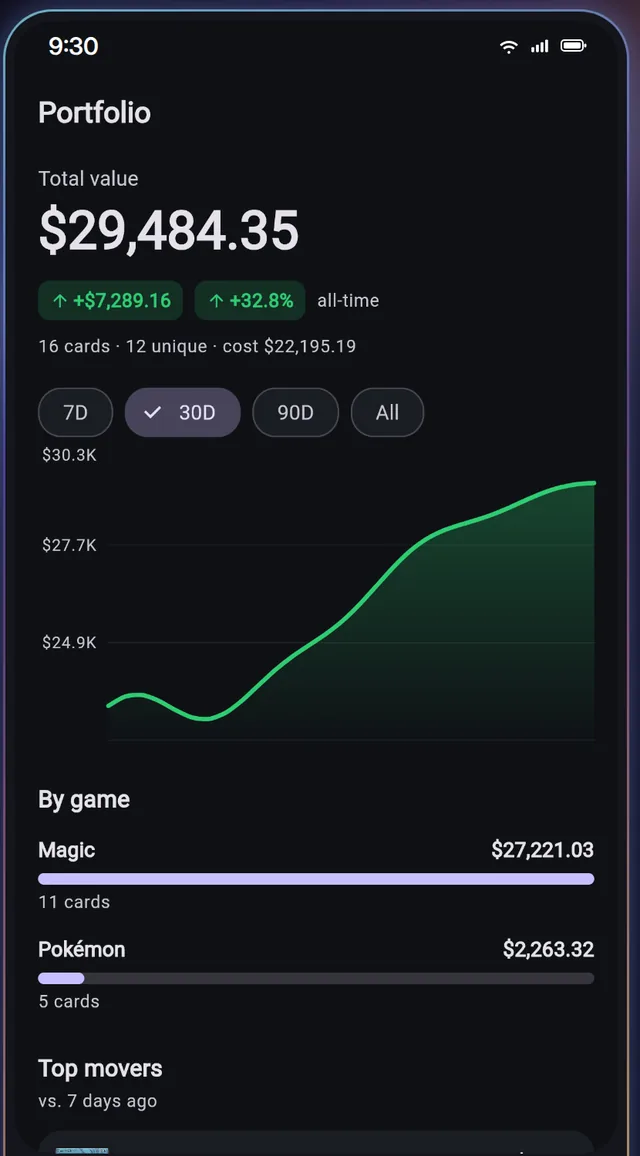
The identifying and the pricing are the parts you shouldn't have to repeat, and a collection's value moves whether or not you're watching. That's what DeckVault is for. Condition stays your call — the total is built from market prices, so read it as a ceiling, not a quote.
Point your camera at a card and it lands in your vault — or scan a photo already sitting in your gallery. Scan photos are never kept on our servers. If you'd rather type, catalog search suggests matches as you go, so you land on the right printing rather than just the right name.
From there the maths runs itself. Every card carries a real market price, and you can record what you paid, so you see gains and losses per card and across the whole collection. Pokémon TCG and Magic: The Gathering share one vault, so the total is the total.
Decks are first-class for both games too: format legality checked live while you build, what you own versus what's missing, what completing a deck would cost, sample hands, plus cloning, exporting and sharing. Share a showcase or a finished deck, or browse what other collectors are building.
Common questions
Can I value a collection by weight?
Only the bulk part. Weight is how thousands of near-worthless commons get traded, and it's a reasonable shortcut for that tail. It tells you nothing about the small group of cards that carries the real value — those have to be identified one by one.
Does a full binder mean it's worth a lot?
Not by itself. Binders fill up with whatever came out of packs, which is mostly the common end of a set. A thin stack of the right printings in the right condition can be worth more than several full binders.
How often do card prices change?
Constantly, and unevenly. Cards that see competitive play move with the metagame and with new set releases. Older collector cards move more slowly but respond to reprints and to attention from outside the hobby. A number you wrote down a year ago is a starting point, not an answer.
Do I need to price every single card?
No, and trying to is the main reason people give up. Price the standouts individually, bundle the middle, treat the rest as bulk. An app that has already recorded each card can keep the whole total current for you without that sorting effort being repeated.
Is DeckVault free?
Free to start — track up to 100 cards and build 2 decks. DeckVault Pro unlocks the full collection and unlimited decks for $4.99/month or $49.99/year. It's on Android via Google Play; iOS is coming later.
Stop estimating. Start counting.
Scan your cards, record what you paid, and watch the total move. Free to start — 100 cards and 2 decks, no payment needed.