 DeckVault
One Pokémon and MTG collection app, instead of two
Both games in one vault: a single portfolio total, one scanner, and a deck builder that knows the rules of whichever game you're building in.
Get it on Google PlayFree · Android · iOS coming later
Most collectors don't stay in one game
The usual story goes something like this. You opened Pokémon packs as a kid, drifted away, then a friend taught you Magic and you drifted back to both. Now there's a Pokémon binder and a stack of Magic commons in the same closet, and your phone has two apps that each know about half your cards.
That split costs you more than screen space. Two logins. Two subscriptions to remember. Two totals that you have to add up in your head — and they aren't really addable, because each app makes its own choices about which printing you own and what condition you assumed. When someone asks what your collection is worth, the honest answer is "I'd have to check twice."
It also hides the thing collectors most want to see: the shape of the whole hoard. Which game is actually carrying your value. Whether the Magic side has quietly outgrown the Pokémon side. Whether that box of bulk you keep moving between shelves is worth sleeving or worth donating to the local league.
What splitting across two apps really costs
| Two trackers | One vault |
|---|---|
| Two totals you add up manually | One portfolio value, with each game's share visible inside it |
| Two scanners with different habits | One scanner, one review step, one place the card lands |
| Deck lists in a third app entirely | Decks that read from the same collection you just scanned |
One portfolio total across both games
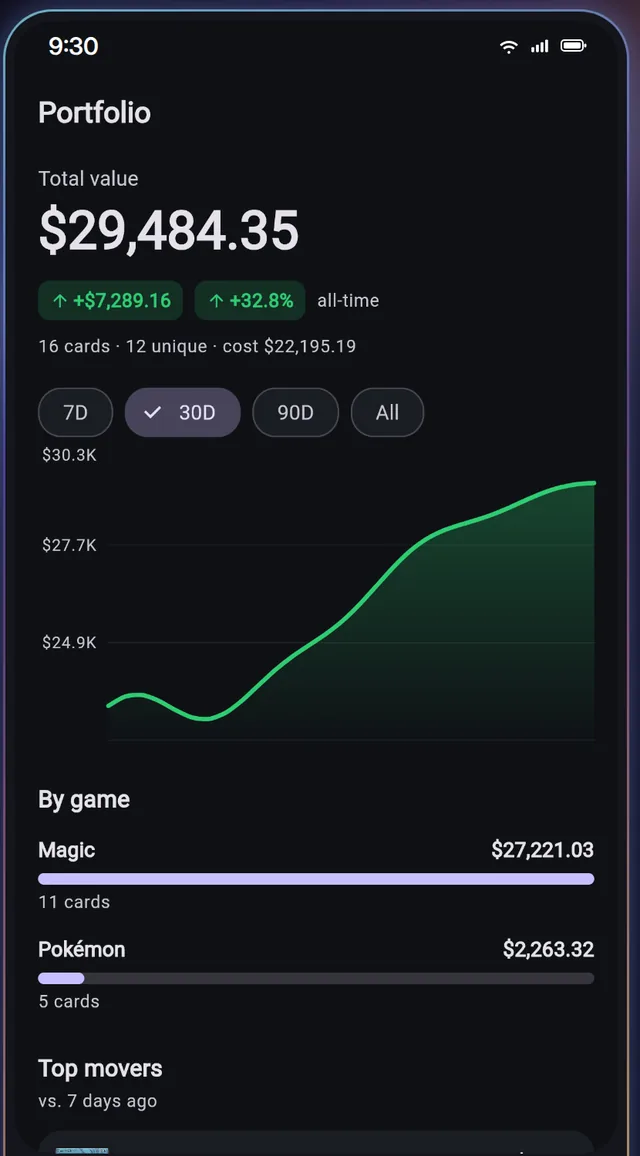
DeckVault gives every card in your vault a real market price, Pokémon and Magic alike, and rolls them into one number. You can also record what you paid, so the app shows gains and losses per card and across the whole collection instead of just a flat valuation.
The per-game breakdown is the part that surprises people. Plenty of players assume their Pokémon chase cards are the bulk of the value and find that a decade of Magic staples quietly out-earned them — or the reverse. You only see that when the two sit in the same view.
One scanner, both card faces
The two games print very different cards, which is why DeckVault's scanner had to learn both rather than one. Pokémon leans on a set symbol and a collector number tucked in a corner, and the same Pikachu shows up across decades of sets with different art. Magic reprints relentlessly — one card can exist in a dozen sets across thirty years, each printing with its own price and its own frame.
DeckVault handles both from the same camera screen. Point it at a card and it goes into your vault, or scan a photo you already have in your gallery — handy for a card you photographed at a shop or in a trade and no longer have in front of you. If the catalog is faster than the camera, search works too, with suggestions as you type. Scan photos are never kept on our servers.
A deck builder that knows which game it's in
This is where "one app for both" usually falls apart. A generic tracker treats a deck as a shopping list. But the two games don't share a rulebook: deck sizes and construction rules differ, which cards are currently legal differs — and all of it changes over time as new sets arrive.
DeckVault checks format legality live while you build, for the game you're building in. It also cross-references the deck against your own vault: you see what you already own, what's missing, and what completing the deck would cost before you commit to it. You can draw sample hands to test whether the curve actually works, then clone, export, or share the list.
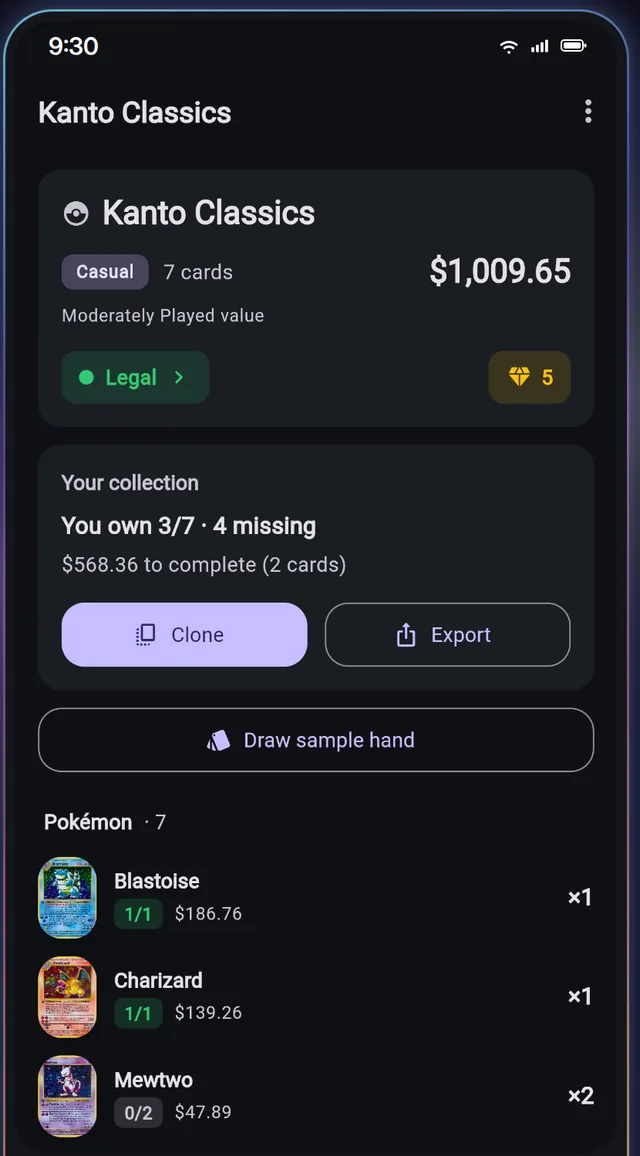
That last bit matters most to two-game players. The cost to complete a deck is only meaningful when the app knows every card you own — including the copy you pulled two years ago in the other game's binder and forgot about.
Collecting and playing are the same hobby
Some apps track value and stop. Others build decks and ignore what your cards are worth. If you play both games, you end up needing all four jobs done, and doing them in four places is how collections go untracked.
DeckVault puts scanning, valuation, deck building and a community feed in one place, with both games treated as equals. Share decks and collection showcases, browse what other collectors are building, and keep the whole hobby under one login.
Common questions
Does DeckVault support any games besides Pokémon and Magic?
No. It's built for Pokémon TCG and Magic: The Gathering, and only those two. That's a deliberate trade — two games, done properly, including deck building for each.
Can I see one total for both games, or separate totals?
Both. Your portfolio shows a single value for everything you own, with each game's share broken out inside it. Gains and losses work the same way, per card and across the whole collection.
Do I have to pick a game when I scan a card?
No. The same scanner handles cards from either game — point the camera at a card, or scan a photo from your gallery. Scan photos are never kept on our servers.
Is deck building really different per game?
Yes, and DeckVault treats it that way. Format legality is checked live for the game you're building in, and the deck is measured against your own collection so you can see what's missing and what it would cost to finish.
What does it cost, and is it on iPhone?
It's free to start: track up to 100 cards and build 2 decks. DeckVault Pro unlocks the full collection and unlimited decks for $4.99/month or $49.99/year. DeckVault is on Android via Google Play today; iOS is coming later.
Put both games in one vault
Free to start — track up to 100 cards and build 2 decks, across Pokémon and Magic together.