 DeckVault
A Pokémon card collection tracker that works like a portfolio
Scan cards in, record what you paid, and watch the value move — instead of retyping a spreadsheet you stopped trusting.
Get it on Google PlayFree · Android · iOS coming later
Why the spreadsheet breaks somewhere around card 200
Almost every collector starts the same way: three columns — card name, set, roughly what it's worth. That's fine for fifty cards. It falls apart in the low hundreds, and it always falls apart for the same reasons.
One name, many cards
Pokémon reprints constantly. The same Pokémon shows up across sets over the years, and within a single set it can exist as a regular, a reverse holo and a full art — and the same Pokémon turns up again as a promo with its own set and numbering. Those are different cards with different values. A row that just says Charizard is a row nobody can price — not even you, six months later. The pieces that actually pin a card down are the set and the collector number, and those are exactly the pieces hand-typing leaves out.
Condition is half the number
Two copies of the same printing can be worth wildly different amounts depending on edge whitening, centring, and surface scratches. Collectors sort roughly into near mint, lightly played, moderately played, heavily played and damaged. On a chase card that scale is the difference between a good week and a bad one. On bulk commons it's noise, because bulk is close to worthless either way — which is its own useful thing to know before you spend an evening sleeving it.
Prices drift while your sheet sits still
Card values move with reprints, tournament results, set rotations, and plain hype. A figure you typed in last winter is a guess about the past. Keeping it current by hand means one marketplace tab per card, and nobody does that past the first fifty. So the sheet quietly becomes fiction, and you stop opening it.
There's a fourth reason, and it's the one that really kills collections: typing is slow. If logging a card takes thirty seconds, you stop logging cards. A half-finished record is worse than none, because you still half-believe it.
What a good tracker actually has to do
Strip away the features and there are only a few jobs. If a tool does these, it stays accurate on its own. If it doesn't, you're back to maintenance.
- Identify the exact printing. Set and number, not just a name.
- Keep prices current for you. Real market data, not a number you typed once.
- Remember what you paid. Value alone is trivia. Value against cost is a position.
- Make entry fast. Seconds per card, or the log dies.
- Hold everything in one place. Cards you're keeping and cards you're playing, in one total.
How DeckVault does it
DeckVault is a collection tracker built around those five jobs. Point your camera at a card and it lands in your vault — or scan a photo you already have in your gallery, which is handy for binder pages and old shots. Scan photos are never kept on our servers. If you'd rather type, catalog search suggests cards as you go.
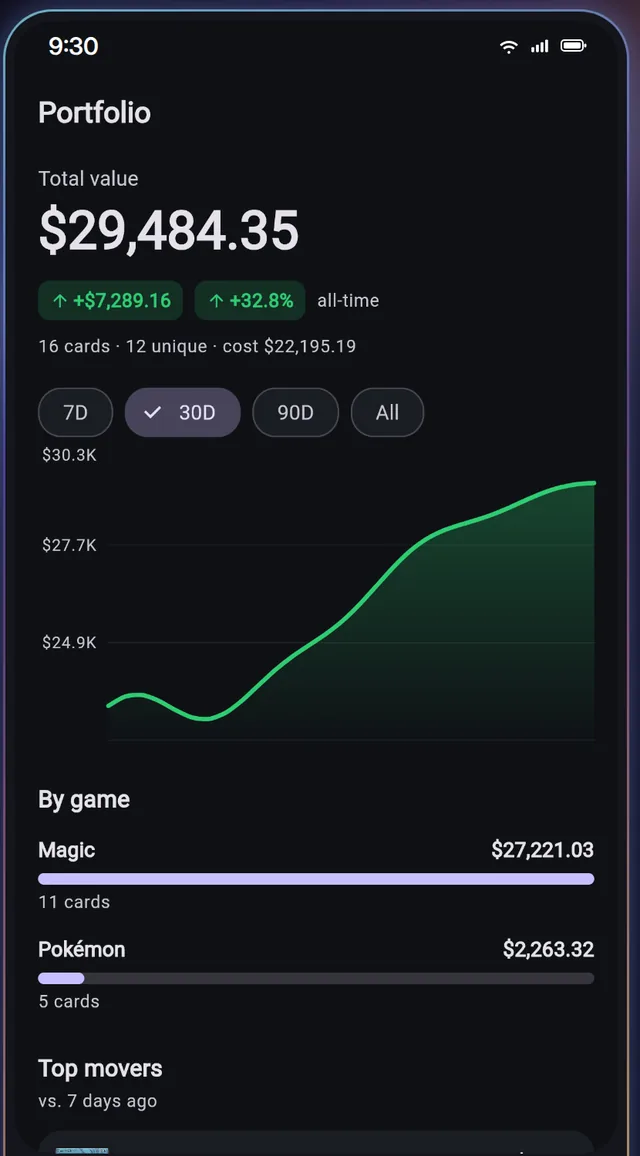
Every card carries a real market price, so your total moves on its own. Record what you paid and you get the part most trackers skip: gains and losses, per card and across the whole collection. That's the difference between a list of cards and a portfolio — you can see which pickups worked and which ones didn't, instead of only seeing a number that goes up when you buy more.
The same vault holds Magic: The Gathering. If you drifted between the two games — plenty of us have — you get one running total instead of two apps disagreeing about your net worth.
Scan cards in
Camera or gallery photo. Scan photos are never kept on our servers.
Cost vs value
Real market prices, plus what you paid, so + gains and losses are visible per card and overall.
Decks that know your vault
Format legality checked live, what you own vs what's missing, the cost to finish, and sample hands.
Show it off
Share decks and collection showcases, and browse what other collectors are building.
Common questions
Is my collection total what I'd get if I sold it?
No, and no tracker's is. Market prices track what copies actually change hands for, and the headline figure leans on clean copies. A played copy is worth less, a shop buying in bulk pays a fraction, and fees and shipping come off the top. Treat the total as a running estimate of what the collection is worth, not a receipt.
Do I have to scan everything?
No. Scanning is the fast path, but catalog search with suggestions as you type works fine, and it's often quicker for a set you're filling in card by card.
Does it track Magic: The Gathering as well?
Yes. Pokémon TCG and Magic are both first-class in DeckVault — same vault, same portfolio total, and a deck builder for each game.
What does it cost?
Free to start: track up to 100 cards and build 2 decks. DeckVault Pro unlocks the full collection and unlimited decks for $4.99/month or $49.99/year.
Is there an iPhone version?
Not yet. DeckVault is on Android, free on Google Play. iOS is coming later.
Start with the binder on your desk
Free to start — track up to 100 cards and build 2 decks, no payment to find out whether you like it.