 DeckVault
An MTG collection tracker that knows your printings
Magic cards are only worth what a specific printing is worth. DeckVault tracks yours that way — then tells you what you can build and what finishing it would cost.
Get it on Google PlayFree · Android · iOS coming later
Why Magic collections resist being counted
Most tracking tools assume a card is a card. Magic has never worked that way. After three decades of reprints, the same card can exist in a long list of printings: the original run, later set reprints, supplemental and boxed products, promos, foils, borderless and alternate-art treatments, and printings in other languages. They all play identically across the table. They are not worth the same, and often not close.
That is where a spreadsheet quietly stops being useful. You type a card name and a quantity. Months later the total is fiction, because the row never recorded which copy is sitting in the box. Set, finish, and condition are not footnotes in Magic — they are most of the value. Two physically identical-looking cards can be separated by a decimal place because one is foil, or from a small early print run, or lightly played rather than near mint.
The other half of the problem is scale. A Magic collection grows sideways. Draft leftovers, a bulk box from a friend who quit, three copies of a staple you keep re-buying because you forgot you had it. Nobody hand-enters that. So most collections stay uncounted, and the honest answer to "what's it worth?" stays "no idea, a few hundred maybe."
The question a tracker should actually answer
A total value is a nice number. It is also a number you look at twice a year. The question a Magic player has weekly is different, and it has two halves:
- What can I build right now from what I already own?
- What would finishing this list cost if I bought the missing pieces as singles?
Those two answers change how you spend. Playsets are the classic trap: you are four cards short of a deck you already mostly own, but you buy a sealed box instead and end up further away. Bulk is the other trap. The overwhelming majority of commons and uncommons in any box are worth close to nothing individually, and sorting them by hand costs more time than they will ever return. A tracker earns its keep by pointing you at the small pile that matters and the short list that finishes a deck.
How DeckVault handles a Magic collection
DeckVault is built around both halves — the portfolio and the decks — for Magic: The Gathering and Pokémon TCG in the same vault, so a collector who plays both only keeps one library.
Scan instead of type
Point your camera at a card to add it, or scan a photo already in your gallery. Scan photos are never kept on our servers.
Value that moves
Real market prices for every card. Record what you paid and see + gains and losses per card and across the whole collection.
Decks, not just lists
Format legality is checked live while you build. See what you own, what's missing, and what completing the deck would cost. Draw sample hands before you sleeve up.
Find the card fast
Catalog search with suggestions as you type, so adding something by hand takes a few keystrokes rather than a hunt.
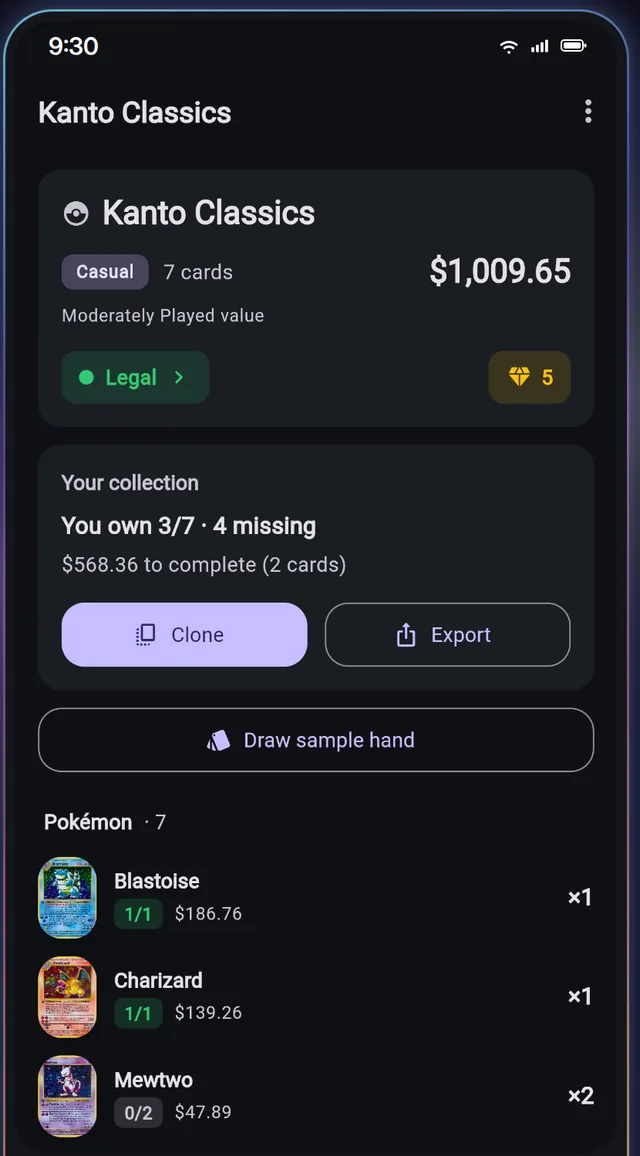
Decks can be cloned, exported, and shared, and you can browse other collectors' builds and collection showcases in the community feed. That last part matters more than it sounds: seeing a finished list next to your own vault is usually how you find out you were three cards away the whole time.
A sane way to start
You do not have to catalogue everything before the app is useful. Start with the cards you would be annoyed to lose — rares, foils, anything old — and scan those first. Add what you paid where you remember it; leave it blank where you don't. Then build one deck you already play and let the owned-versus-missing view show you the gap. Bulk can wait, or stay uncounted forever, which is usually the right call.
Common questions
Does it track Magic and Pokémon in the same collection?
Yes. DeckVault covers Pokémon TCG and Magic: The Gathering, with one vault and one running total across both.
Can I use it for free?
Yes — free covers up to 100 cards and 2 decks. DeckVault Pro unlocks the full collection and unlimited decks for $4.99/month or $49.99/year.
Does it check whether my deck is legal?
Format legality is checked live as you build, so you find out about a problem while you are still adding cards rather than at the table.
What happens to the photos I scan?
Scan photos are never kept on our servers — the card entry stays in your vault, the image doesn't.
Is there an iPhone version?
Not yet. DeckVault is on Android and free on Google Play. iOS is coming later.
Count the collection you already have
Free to start: track up to 100 cards and build 2 decks. Pro unlocks the rest at $4.99/month or $49.99/year.